One List, Three Clocks: Rebuilding My Departure Checklist
I retired a 74 line packing list and rebuilt it as three timed stages. Four departures later, the stopwatch says the idea mostly holds.
My departure checklist turned nine years old this spring, and it showed its age everywhere. It started in 2017 as a phone note with about twenty lines. Every forgotten item since then earned a new line, and the file grew to 74 entries in one long column. Somewhere past line 40, I stopped reading it and started skimming it.
Skimming is the quiet failure mode of a long list. In March I looked straight at the word chargers, felt the box check itself, and left the wall plug in my kitchen. The list had not failed loudly. It failed politely, which is worse, because polite failures never trigger a repair. So I decided to measure how the old list actually performed, retire it, and rebuild the whole thing from a blank page.
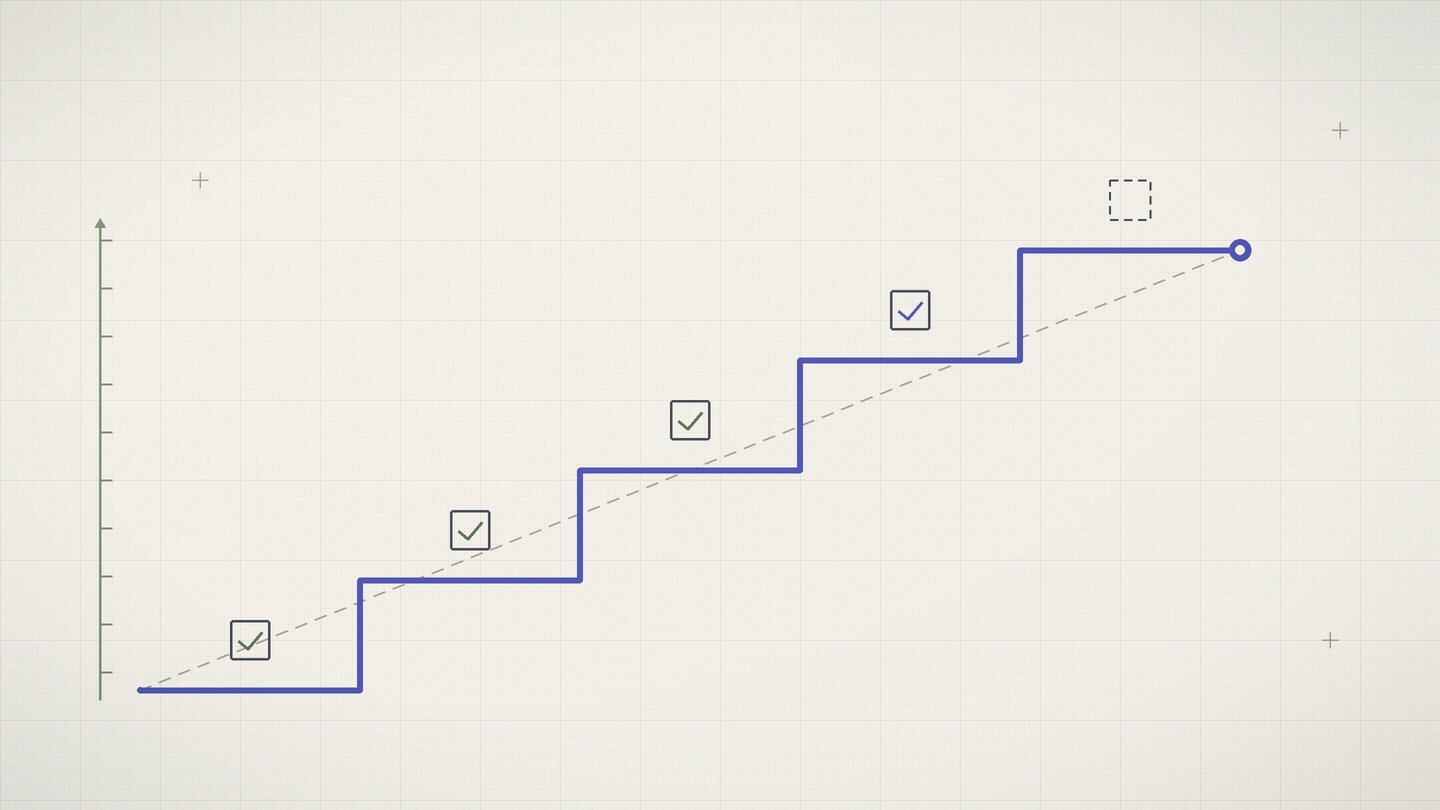
The hypothesis was simple enough to fit on a sticky note. A checklist organized by time before departure should beat one organized by category, because time is what a departure actually runs on. I split everything across three stages: T-7 for seven days out, T-1 for the night before, and T-0 for the walk out itself. The final card carried one hard rule: it must stay short enough that skimming it is physically impossible.
The method
Before touching anything, I collected a baseline that the rebuild would have to answer to. I timed my last two departures under the old list, with a stopwatch running from first zipper to front door. They came in at 96 minutes and 88 minutes, each one a single restless block on the evening before leaving. Across those two trips the old list still let two items slip through: a rain shell and the charger already mentioned.
The rebuild followed four rules, written down before I sorted a single item.
- Every item lands on the latest stage that can still hold it, and nothing moves earlier than it must.
- T-7 holds decisions, not objects. Confirming reservations, running laundry, and repairing worn gear live here, because a decision cannot go into a duffel.
- T-1 holds every object that can sit in a packed bag overnight without consequence. This is the long card, and it is allowed to be boring.
- T-0 holds only objects still in use during the final hour, capped at ten lines. Every T-0 item lives in a tray by the door, so the card and the tray must match at a glance.
Sorting the 74 old entries through those rules took one evening and most of a pot of coffee. Eleven entries died on contact, duplicates and fossils from trips I no longer take. The survivors settled into 14 lines on T-7, 41 lines on T-1, and 8 lines on T-0. Each stage became its own index card, dated in the corner and taped inside the closet door where the old list used to hang.
Field notes
I ran the staged cards through four departures between April 27 and May 16. Two were overnight drives into the high desert, one was a three day work trip, and one was a five day loop that included a rail segment. Different trip shapes stress a checklist in different places, which is exactly what I wanted.
The T-1 evening changed character first. Packing from a card of pure objects, with every decision retired a week earlier, felt closer to shelving books than to preparing a journey. On the first evening I stopped twice to hunt for things that T-7 should have staged, and after that the stops never happened again. The bag was zipped and standing by the door before dark on all four trips.
The T-0 card proved itself on the third departure. I left at 5:40 am for the work trip, an hour when I do not trust my own memory at all. Eight lines, one tray, one pass, out the door. That card replaced a morning sweep through the house that I used to perform twice, never timed honestly, and always resented.
What broke
The first draft of the method failed before the first trip did. I originally drew five stages, adding T-14 and T-3 on the theory that more resolution meant more rigor. T-14 never fired once, and T-3 collected exactly one item, so I collapsed both within a week. For my trips, three stages look like both the floor and the ceiling.
Straddlers surfaced next. A toothbrush is in use at T-0 but wants to travel in the bag packed at T-1, and my first cards listed it in both places. Double listing sounds harmless until you check a box for an object that is not actually in the duffel. The fix was a small marker dot: a T-1 line carrying a dot means the object routes to the door tray, not the bag.
T-7 rotted fastest of the three. Because it holds tasks instead of objects, it behaves like a to-do list, and to-do lists attract passengers. Within two weeks it had swollen from 14 lines to 19, collecting errands that had nothing to do with leaving town. I now prune it back to its printed 14 lines every Sunday, which is one more maintenance ritual than I wanted to own.
Short notice exposed a structural limit. The five day loop was confirmed only 72 hours before leaving, so T-7 had no week to live in. I compressed it into a T-3 card and most of it worked, but the laundry line misfired and I traveled with two shirts instead of four. Weather items showed a similar refusal to commit: the rain shell question cannot be answered the night before a five day trip. Two weather lines now sit on T-0 and get decided at the door with the forecast open.
The numbers
Baseline, old list, two departures: 96 and 88 minutes each in a single block, with two missed items across the pair.
Rebuilt, staged cards, four departures, summing all stages together: 58, 53, 47, and 49 minutes of total handling time. The T-0 morning segments alone ran 11, 9, 7, and 8 minutes. Missed items across all four trips: one pair of sunglasses, a straddler that predated the dot system.
Read plainly, total time fell by roughly 40 minutes per departure. I do not fully trust that figure, because the staged sessions felt calmer and calm hands probably move faster for reasons beyond any card. The shift I do trust is where the minutes now live. The old method concentrated everything into one late block, plus an untimed morning scramble I would estimate at 15 minutes. The new method leaves a measured morning segment under 12 minutes, with the rest absorbed quietly across the week.
The verdict
The staged rebuild stays on the closet door. Four departures make a small sample, one traveler with one duffel is a narrow laboratory, and self timed numbers carry the bias of a person who wants his own method to work. Stated at their honest size, the claims still hold: the three stage split cut my missed items to one, moved the heavy minutes out of departure morning, and made the final hour boring in the way I wanted. It did not shorten packing as much as the raw totals suggest, and it added a weekly pruning chore I still skip sometimes. If your trips fire on less than three days of notice, the top stage folds and the method loses much of its point. Mine mostly do not, so the three cards keep their tape.
What was checked
- Atul Gawande, The Checklist Manifesto, Metropolitan Books, 2009
- A. Degani and E. L. Wiener, research on checklist design and use, Human Factors, volume 35, 1993
- Personal timing logs recorded between April 20 and May 16, 2026